Case study 13 / 13
Learning product
Shodocode
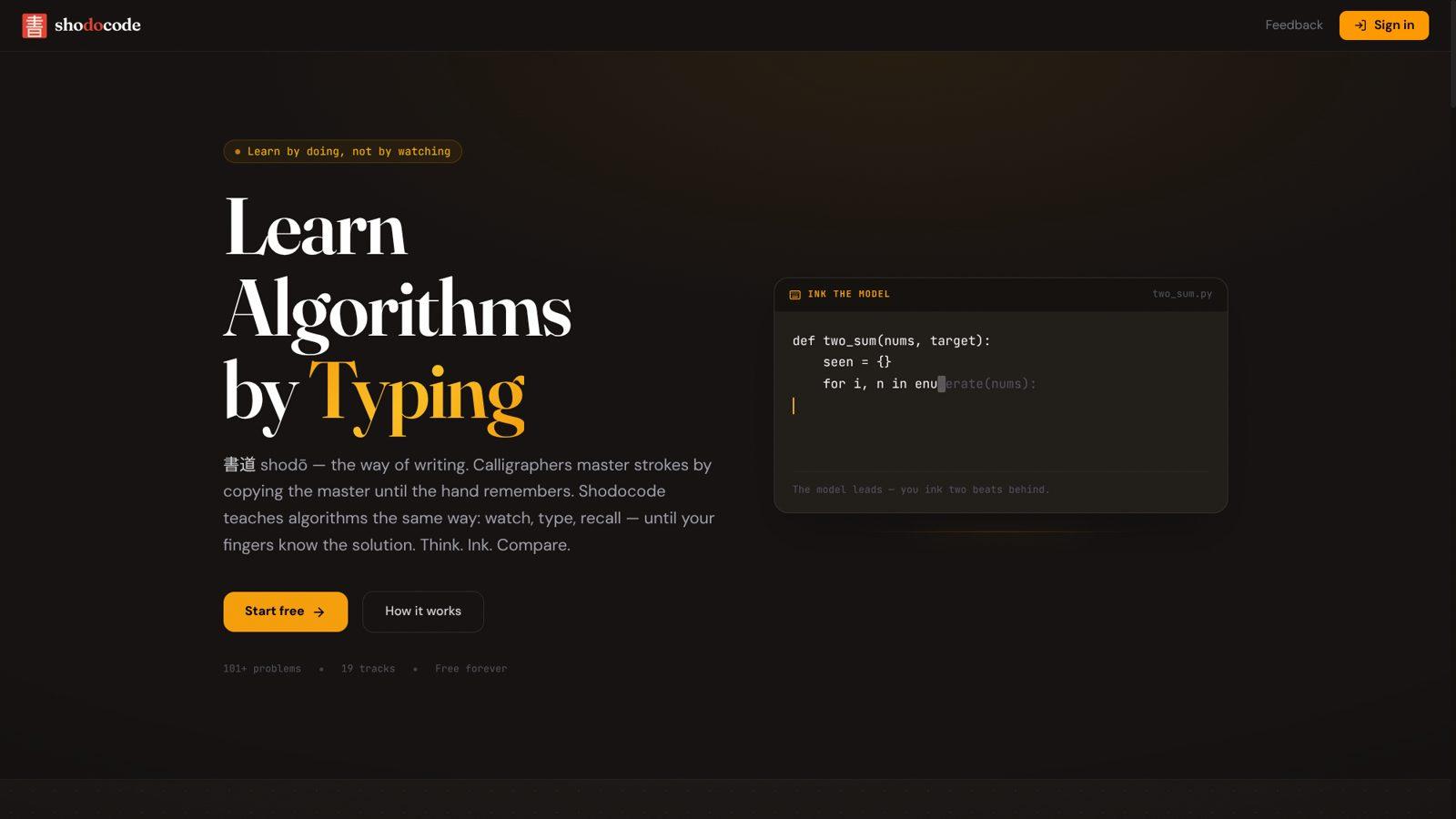
書道 shodō, the way of writing: learn algorithm patterns by copying the master until the hand remembers. Live at shodocode.com.
- Shipped
- July 3, 2026
- Reading time
- 3 min read
The case study
Recognising an algorithm after seeing the solution is not the same as being able to produce it under pressure. Shodocode is a learning product built around that gap. It borrows its metaphor from Japanese calligraphy: study the form, copy the master, and repeat the strokes until the pattern becomes available to the hand.
The learning problem
Most algorithm platforms begin with a blank editor and end with pass or fail. That is useful for assessment, but harsh as a first encounter with a pattern. A learner can understand the explanation, freeze when implementation begins, and receive little guidance about which part of the reasoning disappeared.
Shodocode separates understanding from recall through a three-part loop.
Think, watch, drill
Think
Guided questions ask the learner to identify constraints, invariants, and likely data structures before code appears. The aim is to make the shape of the solution explicit rather than reward a memorized snippet.
Watch
The implementation unfolds beside a synchronized visualization. Code and state changes remain connected, so a pointer movement or queue operation is seen as part of the algorithm rather than an isolated line.
Drill
The learner then types the solution with progressively less support. Repetition is deliberate, but not endless: the product records where recall breaks and schedules the pattern for later review.
Designing the surrounding system
The core loop sits inside a broader learning model:
- spaced-repetition reviews bring patterns back before they disappear;
- algorithm variants reveal which parts of a solution are essential and which are implementation choices;
- daily challenges create a small return habit;
- achievements make progress visible without replacing the learning goal;
- administrative tools keep explanations, drills, and visualizations aligned as content changes.
Product architecture
Shodocode uses Next.js 16, React 19, and TypeScript. Drizzle provides a shared data layer over SQLite locally and Postgres in production. NextAuth handles identity, Zustand manages interactive client state, and Sentry provides production instrumentation.
Vitest and Playwright cover the learning interactions where a content or timing regression would be difficult to spot through static rendering alone. The content tooling is treated as part of the product: a polished learner experience depends on authors being able to verify every step of an exercise.
Current status
The product is in active development. The source remains private while the curriculum and interaction model evolve, but the live application demonstrates the full think–watch–drill loop.
The key design question now is transfer: how much scaffolding can be removed before a learner can solve a variation rather than repeat the exact sequence they practiced?
Continue the conversation
Curious about a decision behind this project?
Keep exploring